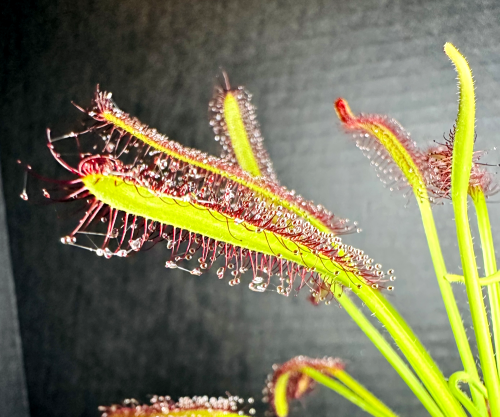
- Drosera capensis
- Drosera binata
- Drosera filliformis
- Drosera spatulata x ultramafica
- Drosera adelae
- Sarracenia purpurea
- Sarracenia x "Scarlet Belle"
- Sarracenia x leucophylla
- Sarracenia flava v. cuprea ("Bill Hoyer" x "Botanique")
- Sarracenia x catesbei (flava v. rugelli "Bob Hanrahan" x purpurea ssp. venosa)
- Sarracenia x swaniana
- Nepenthes x ventrata
- Skeleton Planter Care
- Tropical House Plants
- Succulents and Cacti
- Loofa/Luffa Gourd
- Flowers
- DIY Projects and Misc.
Drosera - The Sundew Plant
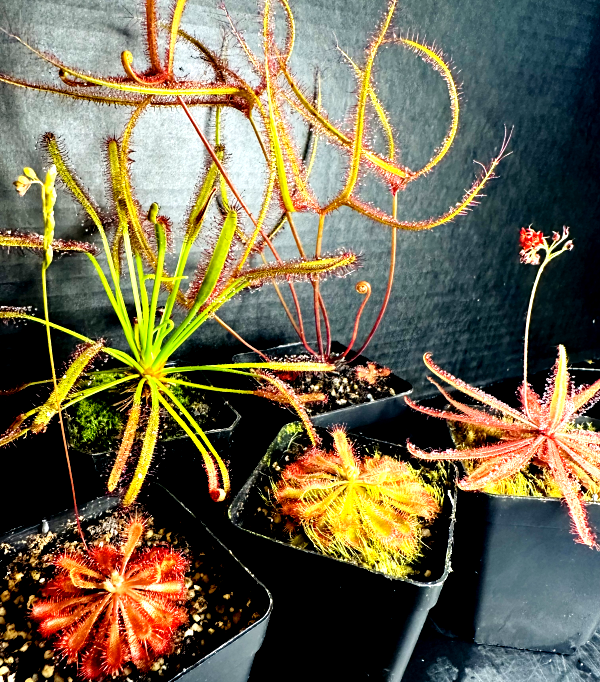
The genus Drosera is made of carnivorous plants that catch their prey using a "flypaper" method. Bugs and other unfortunate tiny critters are attracted to the leaf by a faint alluring odor, and become stuck to the plant by the sticky fluid it secrets. Many carnivorous plants use glue like secretions in their trapping methods- what makes a plant a Drosera species is how the fluid is deployed. The common name “sundew” comes from how their secretions appear to be drops of morning dew suspended on fragile hairs; sunlight reflecting through the fluid in a glittering, delicate, and unassuming display... In reality, it’s a deadly trap. The hairs are referred to as "tentacles" and contain touch receptors that alert the plant when prey lands on it’s leaf. The fluid, as stated earlier, is incredibly sticky. The more the prey struggles, the more covered in this mucus it becomes, and the more stuck it gets. The leaf contracts, moving more tentacles towards the struggling prey; entirely enveloping the victim in goo and eventually wrapping the plant’s leaf around it. The mucilage contains digestive enzymes that break down the ensnared critter, converting it into a bug-soup that can be absorbed into the plant’s leaf.
Sundew require different care than your standard flower or tropical house plant, but once you have the basics down they grow vigorously. I go into greater detail in the species specific guides, but here are the quick Drosera Do's and Don'ts:
- Only water with distilled water.
- Keep your sundew sitting in a saucer of water at all times.
- Give your sundew as much light as you can.
- Never fertilize your plant! No root feeding!
It is not required to feed your sundew, they subsist mostly on sunlight. Photosynthesis and all that. However, that's why you got a carnivorous plant: to feed it. Sundew do well with a crumb of fish food flake, stuck to one leaf, once every month.
Sundew, when happy, produce a drop of "dew" on the ends of their tentacles. If your sundew is not producing dew, one of their care needs is not being met. Do not try to feed them anything if they have no dew to eat it with. The most common causes of sundew stress are low light and dry substrate. If you just brought your plant home and it has no dew, it most likely is stressed from transport. Give it some time to settle in.